
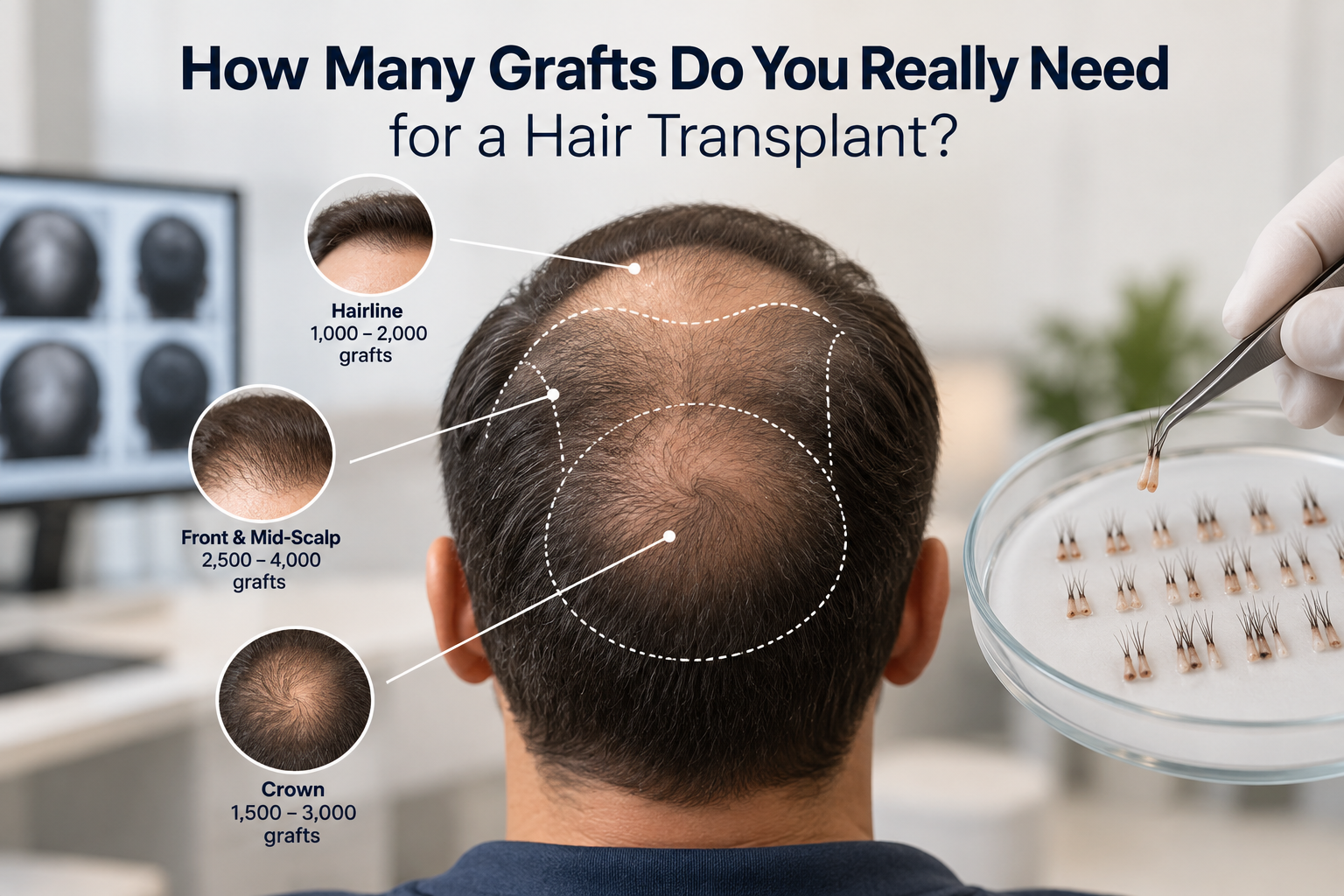
The number of grafts needed for a hair transplant is determined mainly by the size of the thinning area, existing hair density, donor capacity, hair characteristics, and the level of coverage expected.
What Does Graft Count Mean in Hair Transplantation?
A graft count describes how many naturally occurring follicular units are transferred from the donor area into areas affected by hair loss. One graft does not necessarily mean one individual hair because a follicular unit may contain one, two, three, or occasionally more hair shafts.
This distinction matters when estimating potential coverage. Two people receiving the same number of grafts can achieve visibly different density because their grafts may contain different average numbers of hairs. Hair thickness, curl pattern, colour contrast, scalp visibility, and existing native hair also influence how full the result appears.
For this reason, graft numbers should be treated as a planning measurement rather than a direct promise of density. A useful plan considers both the number of grafts available and how effectively those grafts can create visual coverage across the target area.
How Is the Required Number of Hair Grafts Calculated?
The required graft count is calculated by examining the surface area that needs treatment and estimating how much density is necessary within each part of that area. The frontal hairline, frontal zone, mid-scalp, and crown do not usually require identical graft distribution.
Hairline design typically uses carefully positioned grafts because the front of the scalp plays a major role in facial framing. Larger areas behind the hairline can require more grafts overall, even when the planned density per square centimetre is lower.
Existing hair also changes the calculation. A completely bald area generally requires more transplanted follicles than an area where native hair remains between thinning sections.
The calculation therefore combines scalp area, existing density, donor supply, hair characteristics, and long-term planning rather than relying on a single universal graft number.
How Many Grafts Are Needed for Different Areas of the Scalp?
Different areas of the scalp can require substantially different graft numbers because their size, shape, visibility, and desired density are not the same.
A relatively small hairline correction may require around 1,000 to 1,800 grafts. Extending treatment into the frontal third can increase the requirement to roughly 2,000 to 3,000 grafts. Treating both the front and mid-scalp may require around 3,000 to 4,000 grafts.
Crown restoration can require approximately 1,500 to 3,000 grafts depending on the diameter of the thinning area and existing hair.
Advanced hair loss involving several zones can require 4,000 grafts or more. In those situations, distributing available follicles intelligently becomes more important than simply trying to place the largest possible number during one procedure.
How Many Grafts Are Needed for a Receding Hairline?
A receding hairline often requires approximately 1,000 to 2,000 grafts when treatment mainly focuses on restoring the frontal corners and rebuilding the front edge.
A minor recession around the temples may sit toward the lower end of that range. A deeper recession extending across the complete frontal area can require considerably more grafts because the treatment surface becomes wider.
Hairline position also affects the calculation. Creating a lower hairline increases the surface area requiring coverage, which increases the number of follicles needed to maintain convincing density behind the new edge.
Hairline restoration is therefore not simply a matter of filling empty corners. The shape, height, transition into existing hair, frontal density, and long-term pattern of hair loss all influence how many grafts should be allocated to the area.
How Many Grafts Are Needed for the Front and Mid-Scalp?
Treating both the frontal area and mid-scalp commonly requires around 2,500 to 4,000 grafts because these combined regions cover a considerably larger surface than an isolated hairline.
The frontal zone usually receives greater visual priority because it remains visible from most viewing angles. Density can then transition gradually toward the middle of the scalp, allowing grafts to cover a broader area without creating an abrupt change.
Someone with remaining native hair throughout the mid-scalp may require fewer grafts than someone with a completely exposed scalp. Existing follicles contribute to visual density and reduce the amount of empty surface requiring transplantation.
Careful distribution becomes particularly important when the treatment area extends backward. Using too many follicles at the front can leave insufficient donor resources for the mid-scalp or future hair loss.
How Many Grafts Are Needed for the Crown?
Crown restoration commonly requires around 1,500 to 3,000 grafts, although a large crown can require more because this region can cover a surprisingly wide surface.
The crown creates a particular planning challenge because the hairs grow in a spiral pattern. Grafts must follow that natural direction while providing enough coverage to reduce visible scalp.
A small thinning crown with existing hair may need relatively modest reinforcement. A broad, completely bald crown can absorb thousands of grafts without appearing excessively dense because its circular surface expands quickly.
The crown should also be considered alongside the frontal scalp. Using a large portion of the donor supply in the crown may limit the number of follicles available for areas that have a stronger effect on facial appearance.
How Does the Size of the Bald Area Affect Graft Count?
The size of the bald or thinning area directly influences graft requirements because every additional section of exposed scalp increases the surface that needs coverage.
A narrow frontal recession requires far fewer follicles than a pattern extending from the hairline through the mid-scalp and into the crown. Once several regions are involved, trying to maintain identical density throughout the entire scalp may consume donor follicles unnecessarily.
This is why large restoration plans often use graduated density. Greater concentration can be placed in visually important frontal areas while slightly lower density is used farther back.
The objective is not to place the same number of follicles everywhere. Effective planning uses the available grafts where they create the strongest visual improvement while preserving enough donor capacity for later needs.
Does Hair Thickness Change the Number of Grafts Needed?
Hair thickness can significantly influence the number of grafts required because thicker hair generally creates greater visual coverage than fine hair at the same follicular density.
Thick shafts occupy more visible space and reduce the amount of scalp seen between neighbouring hairs. Fine hair provides less coverage, so additional grafts may be necessary to create a similar visual effect.
Curl also matters. Curly and wavy hair can overlap neighbouring areas more effectively, increasing the appearance of volume. Straight, fine hair tends to expose more scalp under bright lighting.
Colour contrast between the scalp and hair can influence the same perception. Dark hair against a light scalp often makes spacing more noticeable.
Graft planning therefore involves more than measuring bald surface area. The physical characteristics of the hair can change how efficiently every transplanted follicle contributes to visible density.
Why Does Donor Area Capacity Matter?
Donor area capacity determines how many grafts can be used safely without leaving the back and sides of the scalp visibly depleted.
The donor region contains a limited number of usable follicles. Once extracted, those follicular units do not regenerate in the original location. Treating donor supply as unlimited can therefore compromise both the appearance of the donor area and options for future treatment.
A person with strong donor density may support a larger graft session than someone with naturally sparse donor hair. Hair calibre, follicular distribution, scalp size, and previous procedures also affect usable capacity.
The goal is not simply to extract as many grafts as possible. A sustainable plan must achieve meaningful coverage while retaining a natural appearance in the donor region and preserving resources for potential future hair loss.
Is 2,000 Grafts Enough for a Hair Transplant?
Around 2,000 grafts can provide meaningful coverage when hair loss mainly affects the hairline, frontal corners, or a limited section of the frontal scalp.
This amount can be particularly effective when native hair remains behind the transplanted area. The new grafts can blend with existing follicles rather than covering an entirely bald surface.
However, 2,000 grafts would usually be insufficient for dense coverage across the front, mid-scalp, and crown simultaneously. Spreading this amount across a very large area may create visible improvement without producing substantial density.
The area receiving those grafts therefore matters more than the number alone. Concentrating 2,000 grafts strategically within a smaller frontal region can often create a stronger visual effect than distributing the same number thinly across several scalp zones.
Is 3,000 Grafts Enough for a Hair Transplant?
A 3,000-graft procedure can cover a moderate area of hair loss and is often suitable when treatment includes the hairline, frontal scalp, and part of the mid-scalp.
This graft count offers more flexibility than a smaller session because follicles can be distributed across different density zones. More grafts can be concentrated around the frontal frame while the density gradually decreases toward areas farther back.
For extensive baldness, however, 3,000 grafts may still require prioritisation. Attempting to cover every visible area can spread the available follicles too thinly.
The strongest result generally comes from matching the graft count to a realistic treatment surface. Three thousand strategically distributed follicles can create a substantial cosmetic change when the plan focuses on the areas where additional hair produces the greatest visual impact.
Is 4,000 to 5,000 Grafts Considered a Large Hair Transplant?
A procedure involving approximately 4,000 to 5,000 grafts is generally considered a large hair transplant because it requires substantial donor harvesting and can cover multiple scalp regions.
These graft counts may be considered when hair loss extends through the frontal third, mid-scalp, and possibly part of the crown. Large sessions can provide broad coverage, but the donor area must support the required extraction without becoming visibly sparse.
More grafts also require careful placement. A large number used inefficiently does not automatically produce a stronger result than a smaller number distributed according to visual priority.
A useful large-session plan considers donor preservation, follicle quality, hairline requirements, scalp surface area, and future progression rather than treating 4,000 or 5,000 grafts as a target that everyone should reach.
Does Higher Graft Count Always Mean Better Density?
A higher graft count does not automatically create a better result because density depends on where follicles are placed, how large the treatment area is, and how effectively the grafts complement existing hair.
Placing 4,000 grafts across a very large bald area may create lower density than placing 2,500 grafts within a smaller frontal zone. Total numbers therefore become meaningful only when viewed alongside the size of the recipient area.
Hair characteristics add another layer. Thick or curly hair can make moderate density appear fuller, while fine straight hair may reveal more scalp even when similar graft numbers are used.
The best use of available follicles focuses on visual effect rather than chasing the highest possible number. Strategic distribution can make a moderate graft count appear considerably denser than poorly planned high-volume transplantation.
Can Too Many Grafts Be Extracted From the Donor Area?
Excessive extraction can leave the donor area visibly thin, uneven, or patchy because transplanted follicles do not grow back where they were originally removed.
The safest donor strategy spreads extraction across an appropriate area instead of concentrating removal within a small section. Maintaining spacing between extraction points helps preserve visual density behind and above the ears and across the back of the scalp.
Overharvesting also reduces future options. Hair loss can continue for years after the first procedure, meaning additional grafts may eventually be useful for newly thinning areas.
Preserving donor follicles therefore forms part of the original treatment plan. The objective should be efficient use of available grafts rather than maximum extraction during a single session.
Should the Hairline or Crown Receive More Grafts?
The frontal hairline usually deserves greater priority when donor grafts are limited because it has the strongest influence on facial framing and remains visible from most everyday angles.
Crown loss can still be treated, but dense crown restoration may consume a large number of follicles. The circular shape and growth pattern of the crown can make it particularly demanding in terms of graft usage.
When both regions require treatment, balancing them becomes important. Building strong frontal coverage and moderate crown improvement can often produce a more balanced appearance than dividing grafts equally.
This does not mean the crown should always be ignored. It means graft allocation should consider how much visual improvement each region can provide for every follicular unit used.
How Is Graft Distribution Planned Across the Scalp?
Graft distribution is planned by dividing the recipient scalp into zones and assigning density according to visual importance, existing hair, surface area, and available donor follicles.
The frontal hairline commonly receives single-hair grafts to create a softer transition. Multi-hair follicular units can then contribute additional volume behind the hairline where individual follicle structure is less visible.
Density can gradually change through the frontal zone and mid-scalp instead of stopping abruptly between sections. When the crown is included, grafts must also follow the natural rotational pattern.
This zoning approach allows a limited donor supply to produce a more coherent result. Rather than treating every square centimetre equally, the plan uses different follicular units and density levels according to the role each scalp region plays.
Can One Hair Transplant Cover the Entire Bald Area?
A single procedure can cover a large area when donor supply is strong enough, but extensive hair loss may require prioritisation rather than attempting maximum density everywhere at once.
Large bald areas can contain far more surface than people initially realise. The front, mid-scalp, and crown together may require several thousand grafts even when moderate density is planned.
Trying to cover the entire scalp with insufficient grafts can create a thin result from front to back. Concentrating available follicles in selected zones may produce a stronger overall appearance.
Some advanced cases are therefore better approached as long-term restoration rather than a one-session attempt to fill every visible gap. The available donor supply should determine the practical limits of coverage rather than the total size of the bald area alone.
How Should Future Hair Loss Affect Graft Planning?
Future hair loss should influence graft planning because transplanted follicles may remain while surrounding native hair continues to thin over time.
A low, extremely dense hairline can consume a large share of the donor supply early in the restoration process. If further recession develops behind that area, additional follicles may then be required to maintain a connected and natural-looking pattern.
A more sustainable approach considers the likely progression of hair loss before deciding how many grafts to use initially. This does not require deliberately creating a sparse result. It means balancing present improvement with future flexibility.
Preserving donor reserves becomes especially important for younger people or anyone showing an active pattern of progressive thinning across several scalp regions.
Three Common Questions About Hair Transplant Graft Numbers
Graft numbers can be confusing because the same figure can produce very different results depending on the area being restored and the characteristics of the available hair.
- Can 1,500 grafts make a visible difference? A 1,500-graft procedure can create a noticeable improvement when concentrated around a receding hairline, temples, or another relatively limited area.
- Are 5,000 grafts necessary for advanced hair loss? Advanced loss may require several thousand grafts, but effective coverage depends on donor capacity and how those follicles are distributed across the scalp.
- Can two people need different graft numbers for similar hair loss? Similar-looking bald areas can require different graft counts because hair thickness, follicular composition, scalp size, native density, and donor characteristics are not identical.
How Many Grafts Do You Actually Need?
The number of grafts you actually need should match the size and location of the thinning area while providing enough density to create a balanced result without unnecessarily exhausting the donor supply.
A limited hairline correction may require roughly 1,000 to 2,000 grafts, while combined frontal and mid-scalp restoration may need around 2,500 to 4,000. Larger patterns involving several scalp regions can require 4,000 grafts or more.
The final number becomes meaningful only when considered alongside surface area and distribution. A well-planned 2,500-graft restoration can create greater visible density than a poorly distributed 4,000-graft procedure.
The practical objective is therefore not to reach the highest graft number possible. It is to use the available follicles efficiently, create appropriate density in the most visible areas, and preserve enough donor capacity for the long-term appearance of the scalp.